Fundamentals
The concepts everyone uses and almost nobody defines: what an API, an SDK, a backend or a database really are.
Database
store and find
A database is a system for storing information, finding it, and keeping it consistent while several operations use it at once. In an online shop, it is where products, stock, and orders live, even when the backend restarts.
How it stores information
In a relational database, information is organised into tables made of rows and columns. Underneath, the engine groups those rows into pages that it can read from disk and keep in memory when they are used frequently.
The application does not touch those files directly. It sends a query and the engine decides which pages to read, how to relate the data, and which changes to write without leaving the information half-updated.
Connections have a limit too
Opening a new connection for every query costs time and resources. A backend therefore usually keeps a pool: a small group of open connections that it lends to each operation and takes back when the operation finishes.
If they are all busy, later requests wait. Increasing the pool without a limit does not create free capacity; it only lets more work reach the database at the same time. If the queries are slow, that can make the problem worse.
An index avoids searching row by row
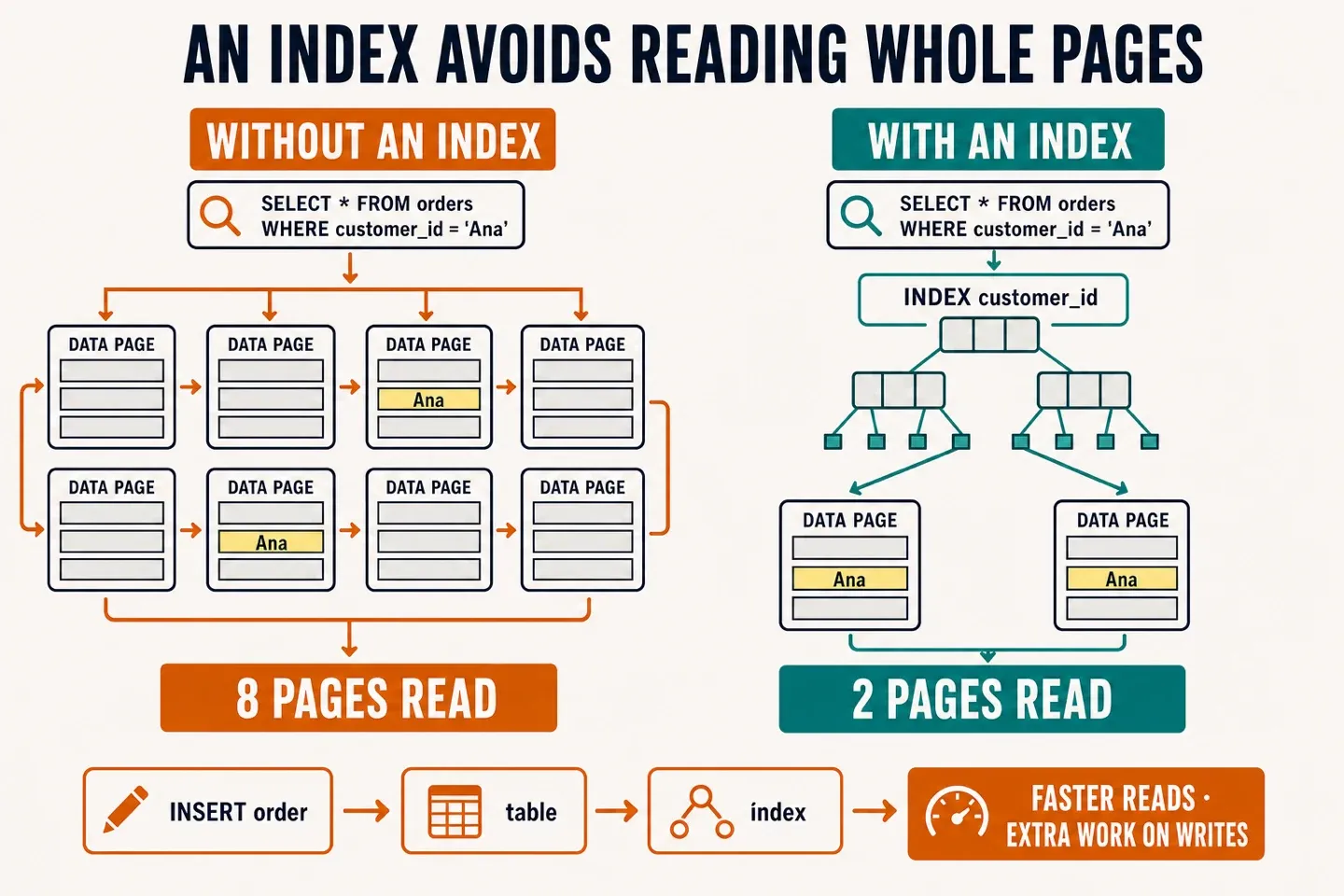
Without an index, finding one customer’s orders may require checking the entire table. An index keeps selected values in an ordered structure and points to the rows where they live. The engine can discard whole blocks of data instead of checking them one by one.
That is why indexes work well for columns used frequently in filters, sorting, or joins. It is also why creating one for every column is a bad idea.
Every INSERT, UPDATE, or DELETE must update the table and every affected
index. Reads become faster; writes pay in extra work and storage.
A query can repeat work without making it obvious
A correlated subquery runs using data from each row of the outer query.
Sometimes that expresses exactly what you need. Other times it repeats the same
access thousands of times when a JOIN, an earlier aggregation, or a batch
query could solve it in one pass.
⚠️ Optimisation is not a collection of tricks. Start with the execution plan: how many rows the query reads, which indexes it uses, and where it spends its time. Without that information, adding an index or rewriting SQL is a guess.